From 14 to 15 May 2026, through our colleague, Flavian Grădeanu, a master's student at the TRANSILVANIA University of Brașov - Faculty of Furniture Design and Wood Engineering, VERTICAL WOOD was present in Brașov at two extremely important events: AFCO 2026, which took place in the Aula of the Transilvania University of Brașov under the aegis of the TRANSILVANIA University, and the 2026 Student Scientific Circles Session (Section 1: Design, Engineering and Restoration of Wood Products), organized by the Faculty of Furniture Design and Wood Engineering.

From 14 to 15 May 2026, through our colleague, Flavian Grădeanu, a master's student at the TRANSILVANIA University of Brașov - Faculty of Furniture Design and Wood Engineering, VERTICAL WOOD was present in Brașov at two extremely important events: AFCO 2026, which took place in the Aula of the Transilvania University of Brașov under the aegis of the TRANSILVANIA University, and the 2026 Student Scientific Circles Session (Section 1: Design, Engineering and Restoration of Wood Products), organized by the Faculty of Furniture Design and Wood Engineering.


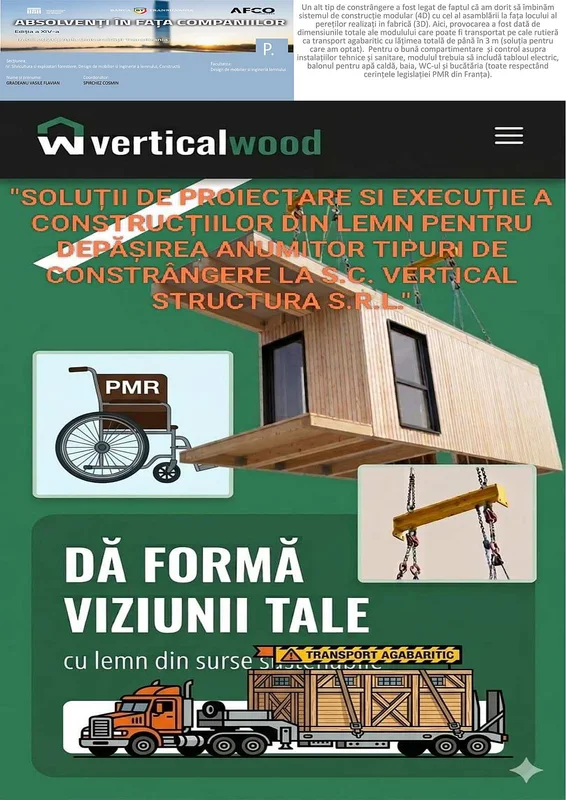
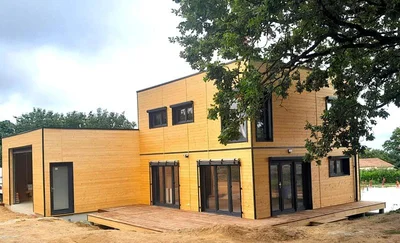
The project presented was entitled "SOLUTIONS FOR THE DESIGN AND EXECUTION OF WOODEN CONSTRUCTIONS TO OVERCOME CERTAIN TYPES OF CONSTRAINTS AT S.C. VERTICAL STRUCTURA S.R.L." and focused on finding the best solutions for the design and construction of a house model for people with reduced mobility, for a client in France. We were confronted with 3 types of constraints:
a) the construction standards for buildings intended for persons with reduced mobility;
b) the combination of the modular construction system (4D) with that of the on-site assembly of factory-fabricated walls (3D) – see also the section Kits & structures - Wall structures;
c) standards for the carriage of exceptional loads by road.


Given the above-mentioned constraints, the main challenge was the dimensions of the module that could be transported by road as an exceptional transport (maximum 3000 mm in width), the multiple dimensions provided for by the construction standards for people with reduced mobility (which also include exterior and interior joinery) that had to be taken into account for the interior design of the living space, among which we mention the 1500 mm one for the wheelchair turning space, and the practical idea of having control over the technical and sanitary installations inside the module, the module having to include the electrical panel, the electric water heater, the bathroom, the toilet and the kitchen.
Relevant products
Articles you might also be interested in